
How to Add Keywords to Your Google Business Profile (Without Getting Suspended)
If you want your local business to rank higher on Google Maps, you absolutely need keywords in your Google Business Profile (GBP). But most business owners are given bad advice on exactly where to put them.
It is never a good idea to try and trick Google. If you force keywords into the wrong fields, like stuffing your city name into your official business title, Google’s algorithm will eventually catch on, and your profile could be permanently suspended.
Here is the straightforward, safe, and effective way to add keywords to your Google Business Profile to actually drive local traffic.
1. The Business Name (Highest Impact, Highest Risk)
Let’s be completely transparent: The name of your business is the single heaviest ranking factor in the Google Maps algorithm. A business named “Bend Plumbers” will almost always outrank a business named “Smith & Sons” for plumbing queries.
Because of this, many business owners try to stuff keywords into their name on Google (e.g., Smith & Sons – Bend Plumbers). Do not do this. If your Google name does not match your legal signage and paperwork, Google can suspend your account (although it seems like they have been very lax the past couple of years).
How to do it safely: If you want the massive ranking benefit of keywords in your name, do it legally. File a DBA (Doing Business As) or Assumed Business Name with your state. If “Smith & Sons” files a DBA for “Smith & Sons Plumbing of Bend,” you can legally use that keyword-rich name on your Google Business Profile, your website, and your signage without fear of suspension.
(Read our full guide on the risks of doing this illegally: Google Business Profile Keyword Stuffing: The Risks & How to Report It).
2. Primary & Secondary Categories (High Impact, Zero Risk)
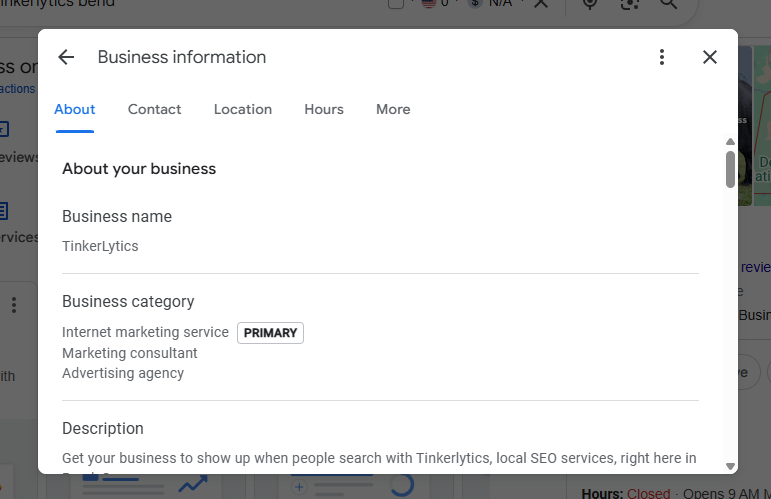
Outside of your actual name, the categories you select are the most important place to tell Google exactly what you do.
How to do it:
- Log into your Google Business Profile dashboard and click Edit Profile.
- Primary Category: Choose the one category that best describes your core business. Be as specific as Google allows.
- Secondary Categories: You can add up to 9 additional categories. Add every single service category that applies to your business. If you are an HVAC contractor, make sure you add Air Conditioning Repair Service and Heating Contractor.
Note: You cannot create custom categories; you must choose from Google’s predefined list. Choose carefully, as these dictate which searches you are eligible to appear in.
3. Understanding Keyword Intent
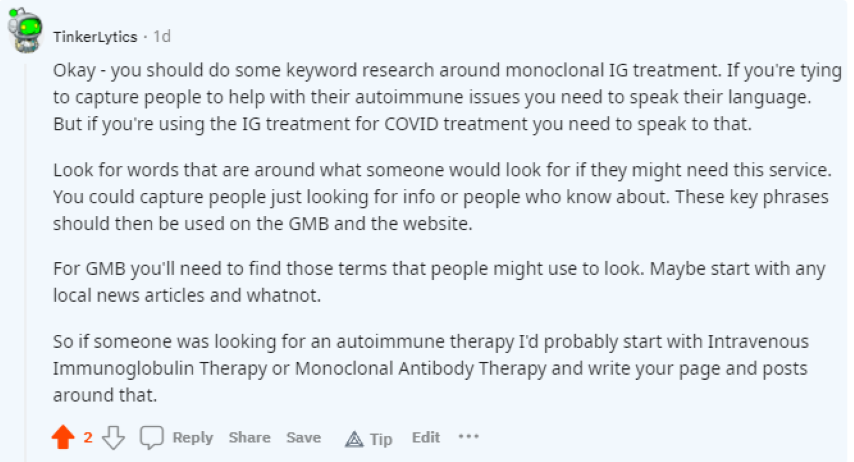
Before you start adding custom services and descriptions, you need to understand Keyword Intent. Intent is the reason behind a searcher’s query.
If someone searches for “how to fix a leaky pipe,” their intent is informational—they want to do it themselves. If someone searches for “emergency plumber near me,” their intent is commercial—they are ready to hire someone right now.
When optimizing your profile, focus entirely on commercial intent keywords. Do not waste space describing the history of your industry or how your products work. Use terms that indicate a readiness to buy, such as “installation,” “repair,” “consulting,” or “services.”
4. Services and Products (Medium Impact)
The “Products” and “Services” tabs are incredible places to inject highly relevant, long-tail keywords into your profile.
How to do it:
- Services: Google will often auto-suggest services based on your categories. Add your own custom services here (e.g., “Emergency Drain Cleaning” or “PPC Consulting”). Write a clear description for each service that naturally includes variations of your keywords.
- Products: Even if you are a service-based business, you can use the Products tab to highlight your core offerings. Add an image, a keyword-rich product title, a description, and a button linking directly to that service page on your website.
5. Customer Reviews (Medium Impact, But Proceed With Caution)
Google reads the text of the reviews your customers leave. When a customer writes, “Jeff did a great job with our local SEO in Bend,” Google registers “local SEO” and “Bend” as keywords associated with your business.
The 2026 Warning: In the past, agencies told business owners to explicitly ask customers to include specific keywords in their reviews. Stop doing this. In 2026, Google’s algorithm is highly tuned to detect and filter out reviews that appear unnaturally keyword-stuffed.
How to do it: Ask for reviews naturally. Ask your customers to describe the specific problem you solved for them. They will naturally use the keywords you want without triggering Google’s spam filters.
6. The Business Description (For Conversions, Not Rankings)
There is a persistent myth that stuffing keywords into your 750-character business description will make you rank higher. Google has explicitly stated that the description field does not directly impact search rankings.
However, it does impact conversions. When a customer finds your profile, the description is your chance to sell them. Write a natural, compelling description of your business. Weave in your core services and your target city so the customer knows they are in the right place, but don’t force it.
How to Use Google’s AI to Write Your Description
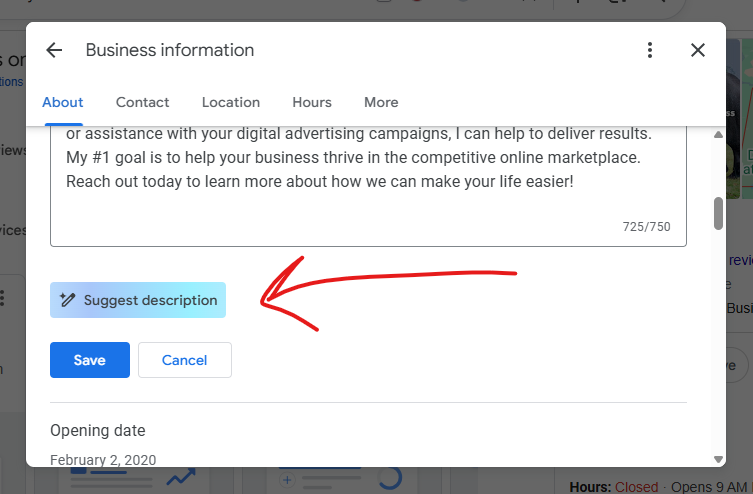
For 2026, Google Business Profile now includes a built-in AI tool to help you generate this description. When you go to edit your description, you can prompt the AI to write it for you.
How to structure your prompt for the best results
To get a description that actually converts, you need to feed the AI specific details. Use this prompt structure:
“Write a 100-word business description for [Business Name], a [Business Type] located in [City]. Mention that we specialize in [Service 1], [Service 2], and [Service 3]. Highlight that we are [Unique Value Proposition – e.g., family-owned, 24/7 availability, data-driven]. Keep the tone professional but approachable.”
A Warning About AI Output: Do not just click “Accept” and publish what the AI generates. Generic, robotic-sounding text can turn potential customers off instantly. Review the output for accuracy. Does it actually sound like your business? Tweak the tone, remove any corporate jargon the AI added, and ensure your core commercial-intent keywords read naturally.
Contact me
If you have questions or are interested in getting this and many other SEO or SEM services, please reach out.
This site is lengthy but definitely worth the read. Good info here! This is what our small and medium business need to grow.